
Correct your presbyopia at Phenicia Vision - Marseille
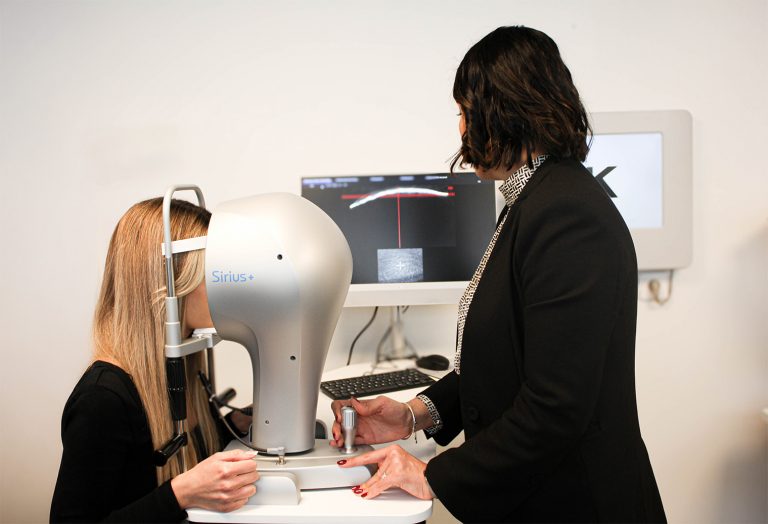
Presbyopia: what is it?
Presbyopia generally appears around the age of 45 and progresses gradually before stabilizing after 15 to 20 years. This phenomenon is age-related and corresponds to a loss of the eye's natural accommodation.
If you feel the need to hold your books or phone further away to see better, this may indicate that your lens is having difficulty contracting enough to ensure clear close-up vision.
What are the symptoms of presbyopia?
Presbyopia is a natural visual disorder that affects the ability to see close up. It results from the loss of flexibility in the lens of the eye, making it more difficult to focus. From the age of 40 onwards, many people find that they have difficulty reading without adjusting the distance, as a result of this gradual loss of flexibility.
How can you correct your presbyopia?
To PHENICIA VISION, we offer tailored solutions to correct presbyopia and improve your everyday comfort. Refractive surgery adjusts the curvature of the cornea to give you clear vision at all distances, without glasses or contact lenses.
Where to "dig" during the operation?
The procedure aims to compensate for the loss of elasticity in the lens by changing the central curvature of the cornea. This improves near vision while maintaining good distance vision, depending on your specific needs.
Which techniques should you choose to treat your vision problem?
- PresbyLASIK : A proven technique for correcting presbyopia, even in cases of associated myopia or hyperopia, with minimal recovery time.
- PKR : Ideal for people with thin corneas or specific professional requirements. Although old, it remains effective and safe.
- SMILE : Cutting-edge technology for presbyopic patients with myopia, offering precise, fast, and minimally invasive treatment.
What results can be expected after refractive surgery?
Thanks to refractive surgery, you can regain clear near and distance vision, as if you were wearing perfectly adjusted glasses all the time. Whether you already wear glasses or contact lenses, this laser correction significantly improves your vision.
Return to Active Life
- PresbyLASIK : Return to work the next day, sports activities after one week.
- PKR : Recovery time of 48 to 72 hours before returning to work; sports permitted after one week.
- SMILE : Almost immediate return to normal activities, without pain.
FAQ – Correction of Presbyopia at PHENICIA VISION
A natural change in the eye around the age of 45, causing increasing difficulty in seeing close up due to the loss of flexibility in the lens.
If you need to hold your documents or phone further away to see better and experience increased eye strain, you are likely to be affected.
- PresbyLASIK : Fast and effective laser correction.
- PKR : Suitable for thin corneas, longer recovery time.
- SMILE : Innovative method for presbyopic myopes, optimized comfort.
No, local anesthesia in drops makes the procedure painless. You may experience slight temporary discomfort afterward.
A few minutes per eye, with approximately one hour on site for the entire procedure.
- PresbyLASIK : Back to work the next day, back to sports after a week.
- PKR : 48-72 hours of recovery.
- SMILE : Immediate resumption of activities.
Yes, presbyopia can be corrected simultaneously with myopia, hyperopia, and astigmatism.
Durable, but the aging process of the eye continues to evolve. A touch-up may be considered after several years.
An eye exam will determine your eligibility based on criteria such as the thickness of your cornea.
Yes, it is recommended to stop one week beforehand to allow the cornea to return to its natural shape.
No, this is a cosmetic procedure that is not covered by Social Security. Some mutual insurance companies offer partial coverage.
- Temporary dry eyes.
- Increased sensitivity to light.
- Luminous halos or temporary discomfort when seeing at night.
Make your first appointment with an optometrist via Doctolib, followed by a consultation with an ophthalmologist to confirm your eligibility and schedule the procedure.