
How can you correct your nearsightedness with refractive surgery?
Do you have trouble seeing distant objects? Do signs, faces, or subtitles on TV appear blurry? You are probably nearsighted.
People with nearsightedness often squint to see better or avoid certain activities, such as driving at night. If this sounds familiar, it may be time to consider a solution.
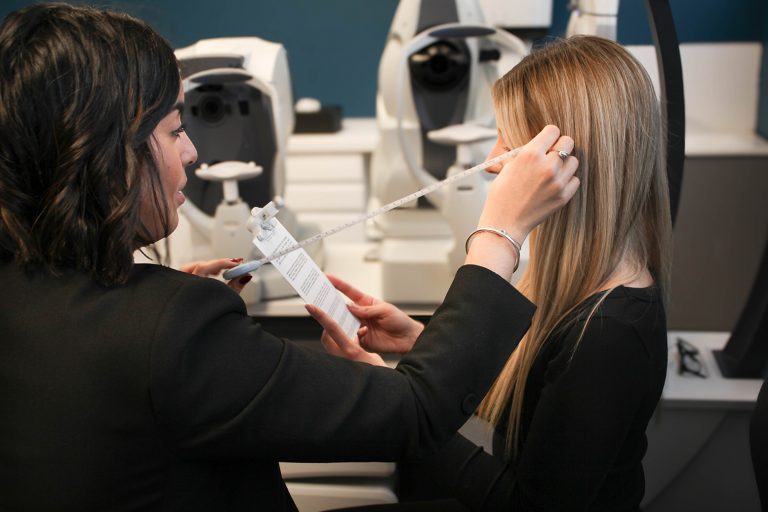
Symptoms of nearsightedness
Myopia is caused by an eye that is too long or a cornea that is too curved, preventing images from forming correctly on the retina.
Consequence : near vision remains clear, while distance vision becomes blurred.
Refractive surgery is a quick and effective method for correcting myopia. Its goal is to reshape the cornea in order to refocus images on the retina and restore clear distance vision.
Good to know
- Myopia usually appears during adolescence and progresses before stabilizing, often before the age of 25.
- Surgical correction is possible when myopia has been stable for at least one year.
- Operating on unstable myopia can lead to a recurrence of visual impairment in the long term.
- Surgery is rarely performed on people under the age of 20, as myopia is still developing.
How is nearsightedness corrected?
During the procedure, excess corneal tissue in the center of the cornea is removed to reduce its curvature. This allows the image to be refocused on the retina and improves distance vision.
Discover our techniques
- LASIK : A quick and effective method, ideal for mild to moderate myopia.
- PKR : Alternative suitable for thin corneas and the specific requirements of certain professions and sports.
- SMILE : Innovative, minimally invasive technique, perfect for moderate to severe myopia.
Imagine a life without glasses or contact lenses. With refractive surgery, regain clear vision and free yourself from visual constraints!
FAQ - Myopia - Phenicia Vision Marseille
It is a visual disorder that prevents clear vision of distant objects, caused by an eye that is too long or a cornea that is too curved.
Difficulty seeing from a distance, need to squint, or discomfort during certain activities (driving, watching movies). An eye exam can confirm this.
Yes, it often appears during adolescence and generally stabilizes before the age of 25.
Refractive surgery improves distance vision by reshaping the cornea.
- LASIK : Fast and effective, suitable for mild to moderate myopia.
- PKR : Ideal for thin corneas or certain professional constraints.
- SMILE : Innovative procedure, suitable for moderate to severe myopia.
No, it is performed under local anesthesia (eye drops). You may experience slight discomfort afterward, but it will quickly disappear.
- LASIK : Return to normal activities the following day.
- PKR : 48-72 hours of recovery.
- SMILE : Quick recovery, no post-operative pain.
Yes, refractive surgery can treat several vision problems in a single procedure.
Anyone whose myopia has been stable for one year and who has no medical contraindications.
Yes, one week before the preoperative evaluation and surgery so that the cornea can return to its natural shape.
No, it is considered a cosmetic procedure, but some health insurance companies offer partial coverage.
- Temporary dry eyes.
- Increased sensitivity to light.
- Bright halos, especially at night (disappear within a few weeks).
Book an eye exam with an optometrist via Doctolib. If your myopia has stabilized, an ophthalmologist will be able to schedule the procedure.