
Perte de cheveux : causes, stades et solutions
Chute passagère ou calvitie définitive, l'origine d'une perte de cheveux peut être très différente d'un cas à l'autre. Cet article fait le point sur les causes, les stades d'évolution chez l'homme et chez la femme, et les solutions médicales disponibles à la Clinique Phénicia.
Les deux types de perte de cheveux
Toutes les chutes de cheveux ne se valent pas. Distinguer une perte passagère, souvent réversible, d'une calvitie définitive, liée à la génétique et aux hormones, est la première étape avant d'envisager un traitement. La prise en charge diffère radicalement selon le diagnostic.
Causes de la chute passagère
La chute passagère, aussi appelée effluvium télogène, correspond à une accélération temporaire du cycle capillaire. Elle est réversible une fois la cause identifiée et traitée. Plusieurs facteurs peuvent la déclencher :
Dérèglement thyroïdien
Une hypothyroïdie ou une hyperthyroïdie perturbent le métabolisme et fragilisent le cycle pilaire. Un bilan sanguin permet de le diagnostiquer.
Carences en vitamines et minéraux
Un manque de fer, zinc, vitamine D, B12 ou acides aminés soufrés affaiblit les follicules pileux. Souvent corrigeable par complémentation.
Stress et choc émotionnel
Un événement difficile peut provoquer une chute massive 2 à 3 mois plus tard. La repousse est généralement spontanée une fois la phase passée.
Changement de saison et pollution
À l'automne notamment, une chute saisonnière modérée est physiologique. La pollution atmosphérique aggrave le phénomène en ville.
Alopécie de traction
Liée au port répété de coiffures tirant les cheveux (queues serrées, tresses, extensions). Touche souvent la ligne antérieure chez la femme.
Pelade
Maladie auto-immune provoquant une chute localisée ou étendue des cheveux et poils. Un traitement par corticoïdes locaux est parfois indiqué.
Chimiothérapie, radiothérapie
Ces traitements entraînent généralement une chute significative pendant la cure. La repousse est habituelle après l'arrêt du traitement.
Trichotillomanie
Trouble compulsif consistant à s'arracher les cheveux. Une prise en charge psychologique adaptée est nécessaire pour traiter la cause.
Alimentation déséquilibrée
Une alimentation pauvre en protéines, vitamines ou oligo-éléments fragilise durablement la fibre capillaire et favorise la chute.
Causes de la calvitie définitive
La calvitie, ou alopécie androgénétique, est la forme la plus courante de perte de cheveux durable. Contrairement aux chutes passagères, elle ne se résorbe pas spontanément : une fois les follicules épuisés, la repousse naturelle ne se fait plus. Deux mécanismes principaux sont en cause.
La prédisposition génétique
Le facteur héréditaire est déterminant. Les antécédents familiaux — du côté paternel comme maternel — donnent une indication forte sur le risque et la vitesse d'apparition. Certaines familles présentent des calvities précoces dès 20 ans, d'autres restent épargnées toute leur vie.
L'action des androgènes (DHT)
Les dihydrotestostérones (DHT) sont des hormones mâles produites à partir de la testostérone. Chez les personnes génétiquement sensibles, cette hormone hypersensibilise les follicules pileux et accélère leur cycle de croissance. Résultat : les cheveux se renouvellent de plus en plus vite, jusqu'à l'épuisement du stock folliculaire et la disparition définitive des cheveux.
Point essentiel : cette hormone n'agit pas sur la couronne hippocratique (la zone située autour et à l'arrière du crâne). C'est précisément pour cette raison que cette zone sert de zone donneuse lors d'une greffe FUE — les follicules prélevés conservent leur résistance génétique une fois réimplantés.
La calvitie touche en moyenne 70 % des hommes au cours de leur vie, avec une apparition typique vers la trentaine. Les cas précoces, entre 18 et 25 ans, sont plus rares et dépendent de facteurs hormonaux mais aussi extérieurs (alimentation, hygiène de vie, carences).
Carences nutritionnelles et chute de cheveux
Une chute qui persiste au-delà de quelques semaines mérite un bilan biologique. Les vitamines et minéraux jouent un rôle central dans le cycle pilaire : ils participent au renouvellement des cellules du bulbe folliculaire et à la synthèse de la kératine. Une carence, même modérée, peut fragiliser durablement la chevelure.
Carence fréquente chez la femme, souvent liée à une anémie. Présent dans les lentilles, épinards, viande rouge. Un dosage de la ferritine est plus précis qu'un simple bilan du fer sérique.
Activateur enzymatique essentiel à la synthèse des protéines capillaires. Il aide à fixer la kératine et favorise la repousse après une phase de chute.
Son manque affaiblit les follicules pileux. Facteur aggravant fréquent de la chute réactionnelle saisonnière, notamment en automne et en hiver.
Indispensable à la croissance cellulaire. Une carence, fréquente chez les végétariens et végétaliens, ralentit le renouvellement folliculaire.
La cystéine est le précurseur direct de la kératine, constituant principal du cheveu. Son absorption diminue avec l'âge, d'où l'intérêt des compléments adaptés.
Intervient dans la production du sébum qui protège la tige capillaire. Attention toutefois : un excès peut paradoxalement déclencher une chute.
Le bilan sanguin préconisé lors de la consultation permet d'identifier précisément les carences. Une complémentation ciblée ou un ajustement alimentaire suffit souvent à ralentir ou arrêter la chute, en particulier lorsque l'alopécie androgénétique n'est pas en cause.
Stades d'alopécie chez l'homme — Classification d'Hamilton-Norwood
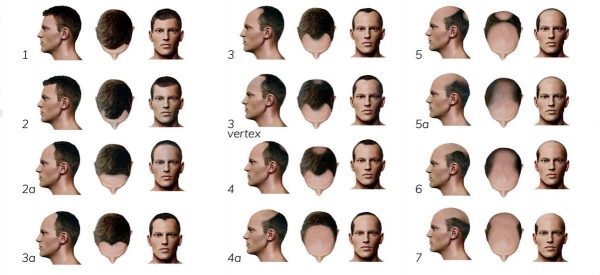
La classification d'Hamilton, affinée par Norwood, décrit 7 stades d'évolution de la calvitie masculine. Elle sert de référence internationale pour évaluer l'avancement de l'alopécie et orienter la stratégie thérapeutique, notamment le nombre de greffons à prévoir lors d'une greffe FUE.
Golfes temporaux à peine visibles
Recul minime de la ligne frontale. Aucune perte significative. À ce stade, la greffe n'est pas indiquée.
Golfes marqués, pointe frontale qui s'efface
Les golfes temporaux reculent, un éclaircissement local peut apparaître. Premiers signes d'une alopécie qui s'installe.
Creusement profond des golfes temporaux et frontaux
La ligne frontale dessine un M caractéristique. Le vertex (sommet du crâne) peut commencer à s'éclaircir. Stade où une greffe est envisageable.
Creusement symétrique important, vertex dégarni
Calvitie complète au niveau de la tonsure. La bande de cheveux séparant les deux zones reste visible mais s'amincit.
Confluence des zones antérieure et postérieure
La bande frontale et le vertex commencent à se rejoindre. La surface dégarnie s'étend significativement.
Extension marquée au-delà de la tonsure
Les zones frontale et vertex sont complètement fusionnées. Il ne reste plus qu'une couronne latérale et postérieure.
Alopécie hippocratique — couronne basse uniquement
Stade le plus avancé. Seule subsiste une couronne étroite de cheveux en arrière et sur les côtés. La densité de la zone donneuse conditionne alors la faisabilité d'une greffe.
Classification d'Hamilton-Norwood — stades 1 à 7 de l'alopécie masculine
Stades d'alopécie chez la femme — Classification de Ludwig
L'alopécie féminine se manifeste différemment de celle de l'homme : plutôt qu'un recul de la ligne frontale, elle se traduit par un affinement diffus et un élargissement progressif de la raie centrale. La classification de Ludwig, en 3 stades, est l'outil de référence pour évaluer son évolution.
Alopécie modérée du vertex
Élargissement de la raie médiane sur le haut du crâne, s'étendant sur 2 à 3 cm. La ligne frontale reste intacte. Souvent le premier signe observé par les patientes.
Extension latérale
L'éclaircissement s'étend de part et d'autre de la raie. Il se rapproche de la ligne antérieure sans l'atteindre, à environ 1 cm de distance. La densité globale diminue.
Alopécie quasi totale du vertex
Le sommet du crâne est dégarni, avec conservation habituelle de la ligne frontale et de la couronne. Stade le plus avancé de la classification.
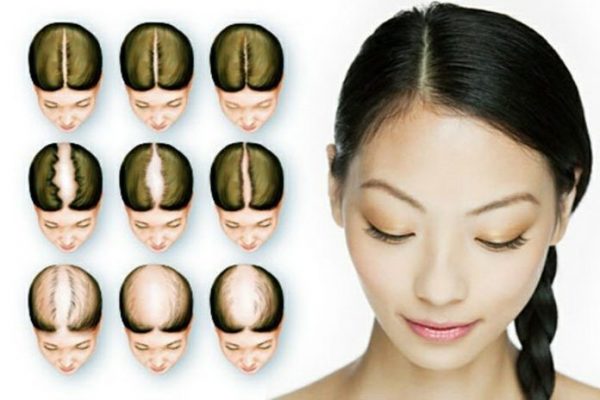
Classification de Ludwig — stades 1 à 3 de l'alopécie féminine
Chez la femme, une chute de cheveux doit motiver une consultation pour écarter une cause hormonale, nutritionnelle ou thyroïdienne. La greffe FUE peut être indiquée dans certains cas bien ciblés, après stabilisation de la chute et évaluation de la qualité de la zone donneuse.
Solutions médicales contre la perte de cheveux
La Clinique Phénicia propose une approche graduée : selon le stade, la cause et l'âge du patient, la solution adaptée n'est pas la même. Voici les principaux traitements disponibles.
FUE hair transplant
Transplantation d'unités folliculaires un par un, sans cicatrice linéaire. Solution définitive pour les alopécies installées (Norwood III à VII). Résultat naturel, repousse progressive sur 12 à 18 mois.
Découvrir la greffe FUE →Injections PRP
Plasma Riche en Plaquettes prélevé sur le patient puis réinjecté dans le cuir chevelu. Stimule les follicules encore actifs, ralentit la chute. Approche préventive ou en entretien post-greffe.
PRP capillaire à Marseille →Hair mesotherapy
Micro-injections de vitamines, acides aminés et oligo-éléments. Renforce la fibre capillaire, améliore la qualité du cuir chevelu. Plusieurs séances nécessaires pour un effet durable.
Mésothérapie capillaire →Hair exosomes
Traitement de pointe utilisant des vésicules porteuses de facteurs de croissance. Stimule l'activité folliculaire et favorise la repousse. Particulièrement indiqué en cas de chute diffuse.
Exosomes capillaires →TrichoTest — analyse ADN
Test génétique personnalisé identifiant les causes précises de votre chute et les traitements auxquels vous répondrez le mieux. Outil d'aide à la décision avant tout protocole.
Découvrir le TrichoTest →LaseMD Keralase
Laser fractionné couplé à des sérums spécifiques. Améliore la pénétration des actifs, stimule la microcirculation du cuir chevelu. Complémentaire aux autres approches médicales.
LaseMD Keralase →Obtenez un bilan capillaire personnalisé
Remplissez le formulaire ci-dessous pour recevoir une évaluation personnalisée de votre situation. Un chirurgien analysera votre dossier et vous orientera vers la solution la plus adaptée.