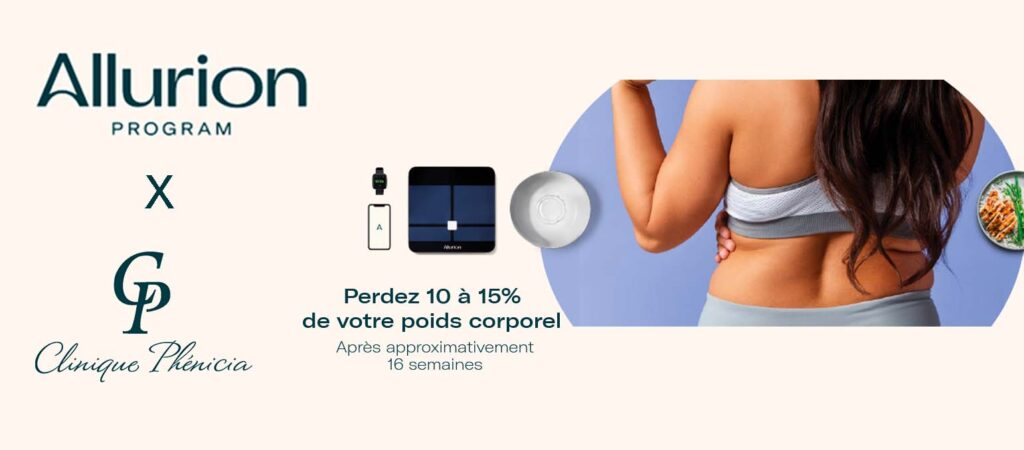
Allurion, the first temporary gastric balloon for sustainable weight loss without anesthesia or surgery
The Phénicia Clinic and its experts have chosen the Allurion Balloon, which is less restrictive than all other intragastric balloons.
The Allurion Balloon promotes satiety and reduces food consumption.
More than 80,000 patients worldwide have already benefited from this safe procedure.
An initial consultation at the Phénicia Cosmetic Surgery Clinic in Marseille will allow our dietitian to conduct a thorough examination to check your medical history, ensure that the Allurion gastric balloon is suitable for you, and assess your determination.
If you are interested in this method, a second appointment with thegastroenterologistwill be scheduled.
The Allurion program is based on three components, ranging from the insertion of the gastric balloon todietary monitoring, withweight controlusing a connected scale andphysical activitymonitoring using a connected watch.
A genuinealternative to bariatricsurgery (gastric banding, sleeve gastrectomy, and bypass) for patients with a BMI (Body Mass Index: weight divided by height squared) over 30.
Procedure at the Phénicia Clinic
Allurion is a revolutionary soft gastric balloon that can be placed in the patient's stomach by a doctor in just 15 minutes.
There is no surgery or anesthesia involved; the patient simply needs to fast for more than 8 hours before the procedure.
The Allurion balloon is a gastric or intragastric balloon contained in a vegetable capsule.
It is a simple procedure: the patient simply swallows this soft capsule, which then expands in the stomach.
After radiographic confirmation that the balloon is correctly positioned in the stomach, it can be filled. Filling, which involves 550 ml, is painless and risk-free. After filling, the insertion catheter is removed from the device with a gentle pull. The filled Allurion balloon is designed to remain in the stomach for approximately 16 weeks. However, the duration of the balloon's stay may vary from patient to patient.
A thin valve will open after four months under the influence of gastric acidity, allowing the water to drain out.
Its thin, biodegradable membrane is then dissolved and eliminated in the digestive tract's stool.
You probably won't even notice it.
Contraindications for the Allurion program
The use of antispasmodics and antiemetics helps patients get through the initial phase of nausea, vomiting, and abdominal pain, which are temporary.
Normal activities can be resumed very quickly, within 1 to 2 days.
Contraindications (non-exhaustive list)
- Substance addiction
- Pancreatitis
- Congestive heart failure, arrhythmia.
- Cancer
- Pregnancy
Any history:
- Bariatric, gastric, or esophageal surgery
- Laparoscopic band ligation
- Surgical treatment of reflux
Support at the Phénicia Clinic
Throughout your journey, you will have a dedicated team of experts by your side who specialize in treating obesity.
A six-month multidisciplinary program involving medical (gastroenterologist), psychological, and nutritional care is planned in addition to physical exercise, enabling an average weight loss of 10 to 15% of total body weight or more.
The patient's physical progress is monitored using scales and a connected watch. (Weight curve and BMI)
The patient is supervised by a trained dietitian-nutritionist who will conduct at least six mandatory follow-up visits during this period.
We are proactive in monitoring our patients; we don't wait for mandatory appointments with patients to observe their progress.
We monitor progress in real time and ensure that patients stay on track with their weight loss goals.
We encourage you, send alerts via secure communications on the platform, and organize in-person appointments at the clinic or video appointments with our hypnotherapist, dietitian, and gastroenterologist.
Optional but recommended meetings are organized based on the patient's questions.
Our patients' participation in this follow-up program improves the results of our weight loss treatments.
Long-term dietary monitoring is available with your dietitian after the balloon is removed in order to proceed with the stabilization phase.
Following this weight loss, any issues related to body contouring can be addressed through both aesthetic medicine and cosmetic surgery.
Prices:
First consultation freeof charge
Gastroenterologist consultation (only after the first appointment): €80
ALLURION program Duration 6 months: €3,690
Payment facilities x3 x4
Frequently asked questions
The system consists of a flexible, expandable balloon and a single-use placement and filling device that does not cause any allergic reactions. Placement is performed under radiological guidance without endoscopy. No general anesthesia is required. There are no scars.
The system is designed to facilitate adherence to a diet and a program of dietary behavior modification. The balloon partially fills the stomach and creates a feeling of fullness.
The balloon is inserted deflated into the stomach through the mouth and then the esophagus, under radiological and ultrasound guidance. The empty balloon is inserted into the stomach and then filled with sterile saline solution (approximately 550 ml). The filling connector is then disconnected. When full, the balloon is too large to pass into the intestine and remains mobile in the stomach.
The system is designed to aid weight loss in individuals whose weight significantly exceeds their ideal weight (BMI greater than 27) and who have been unable to achieve sustained weight loss through other weight management programs.
The balloon is equipped with a filling valve that spontaneously disintegrates after approximately 16 weeks due to gastric acidity. It then empties spontaneously and migrates empty into the intestine before being expelled with the stool, usually painlessly.
While the balloon is in place, anti-secretory treatment prescribed during monthly follow-up appointments reduces gastric acid secretion and protects the balloon and the stomach wall, thereby reducing the risk of ulcers that could lead to gastric or duodenal perforation.
The small size of the balloon allows it to migrate through the intestine and be spontaneously evacuated in the stool without incident.
This system aids weight loss, but it must be accompanied by a diet that involves changing eating habits and increasing physical activity. Weight loss averages 10 to 15 kilograms during the period of use and can continue beyond that.
The balloon in the stomach creates a feeling of fullness. Once it is removed, you will be more likely to maintain your weight loss if you continue to follow the dietary changes you became accustomed to while it was in place.
Nausea or vomiting and abdominal pain are common during the first few days. Prescribing antiemetics and analgesics is therefore useful, in addition to potassium replacement.
Excessive initial weight loss can lead to dehydration and require intravenous fluids to restore electrolyte balance due to the risk of potassium loss.
15 to 35% do not achieve results following obesity surgery.
Up to 37% of patients using weight loss drugs such as receptor agonists lose no more than 5% of their total weight.
Notice